
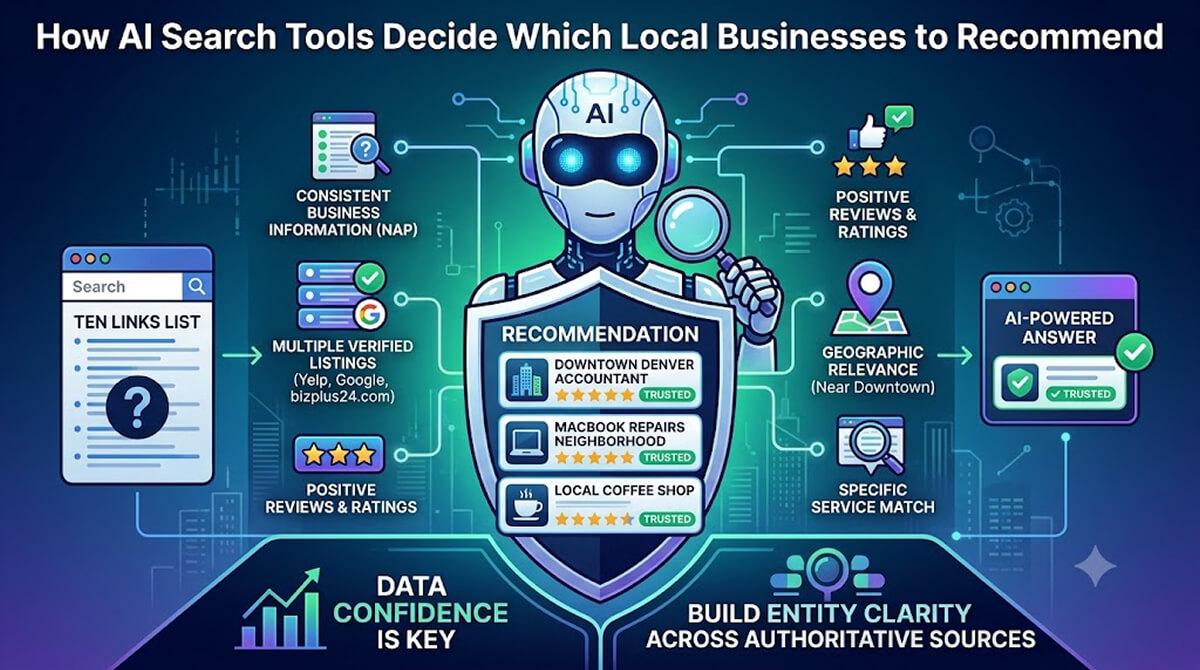
Something meaningful is changing in how people find local services. Instead of clicking through pages of results, a growing number of people ask AI-powered tools directly: “What’s a reliable accountant near downtown Denver?” or “Who does MacBook repairs in my neighborhood?” AI gives them a specific answer not a list of ten links, but an actual recommendation. Understanding how that recommendation gets generated has become genuinely useful knowledge for any local business owner.
AI Search Is a Fundamentally Different Kind of Visibility Problem
Traditional local search returned a list. AI search synthesizes that list and makes a recommendation. The difference isn’t small it changes what it means to be visible in local results.
In traditional search, ranking on page two still gave you some exposure. In AI-generated responses, if you’re not in the recommended set, you’re effectively invisible. This shifts the value of the signals that lead to AI recommendations and raises the stakes of maintaining strong, consistent local data.
What AI Tools Are Actually Evaluating
AI-powered search tools don’t rank businesses the same way traditional algorithms do. They’re looking for data confidence how much reliable, consistent information exists about a business across multiple trustworthy sources that can be cross-referenced and confirmed.
A business appearing on Google Business Profile, Yelp, and multiple established directories with consistent information is easier for an AI to confidently recommend than one existing in only one or two places. The AI can cross-reference and verify. A business that exists primarily on its own website is much harder to confirm as legitimate from a third-party perspective.
Being listed on established business directories bizplus24.com among them is part of building the multi-source data consistency that AI recommendation tools need to confidently include your business in relevant local suggestions.
The Entity Recognition Factor and Why It Matters
AI search tools use entity recognition they identify businesses as distinct, verifiable entities and associate specific attributes with them: location, industry, services, hours. The more consistently your business name, address, and information appear across authoritative sources, the more clearly defined your entity becomes within these AI knowledge systems.
Specificity in your business descriptions, consistent use of your location and service area, and precise category labeling all improve your entity clarity. Vague, marketing-heavy descriptions that could apply to any business in your industry do almost nothing for AI discoverability.
Frequently Asked Questions
Are AI search recommendations based on paid placement?
Generally, no. AI search recommendations are based on data confidence and relevance, not advertising spend. Organic local optimization consistent citations, complete listings, specific business descriptions directly influences how prominently AI tools surface your business.
How is optimizing for AI search different from traditional local SEO?
Traditional local SEO focuses on ranking website pages for keyword searches. AI search optimization focuses on making your business easily identifiable and confidently recommendable across multiple structured data sources. Both matter, but they require different emphases.
What's the simplest thing I can do to improve my AI search visibility right now?
Make your business information consistent, specific, and accessible across multiple reputable platforms. Start with Google Business Profile, then expand to established directories. The more places that accurately confirm the same information, the more confidence AI systems have recommending you.
Do online reviews influence AI search recommendations?
Yes. Review quantity, recency, and content can influence how prominently a business appears in AI-generated recommendations. Reviews mentioning specific services and locations give AI systems richer, more confident data to work with when constructing recommendations.
Should I optimize for AI search or traditional local search results?
Both and they share the same foundation. Consistent citation data, complete and accurate Google Business Profile, and specific business descriptions serve both traditional and AI search well. You don't need separate strategies; the fundamentals are the same.